Know what your Mac is holding. Take the space back.
CoreTend reads supported locations on-device and explains each finding. Sensitive actions require a reviewed selection and explicit confirmation before eligible items are handed to the macOS Trash.
02 Workflow
Three moves. Nothing leaves until the third.
Most cleaners delete first and tell you after. CoreTend reverses the order: read, show, then act — and only when you ask.
-
01
Scan
Storage, Space Lens and Duplicates stream results while they scan; Applications and Integrity also inspect local metadata. Scan indexes stay on the Mac. Only a manual update check requests the public latest.json manifest.
Cooperative pause, resume and cancellation are available in Storage, Space Lens and Duplicates. -
02
Review
Each row carries its path, size and reason. Quick Look and Finder help you verify it. Some low-risk Storage categories and non-kept duplicate copies start selected, so review them before acting.
System locations are protected. Space Lens can scan the home folder or a folder you choose; Duplicates also includes Documents among its supported locations. -
03
Act
Every result remains inspectable before action. After explicit confirmation, CoreTend asks macOS to place eligible items in the Trash and adds an aggregate entry to the local record, which can be exported as CSV or JSON.
CoreTend has no built-in restore action after removal. Check the Trash and use Put Back when macOS successfully placed the item there.
03 What ships
Eight modules. Nothing promised beyond them.
This is the actual architecture of 0.9.1. If a capability is not on this list, it is not in the app.
- Home
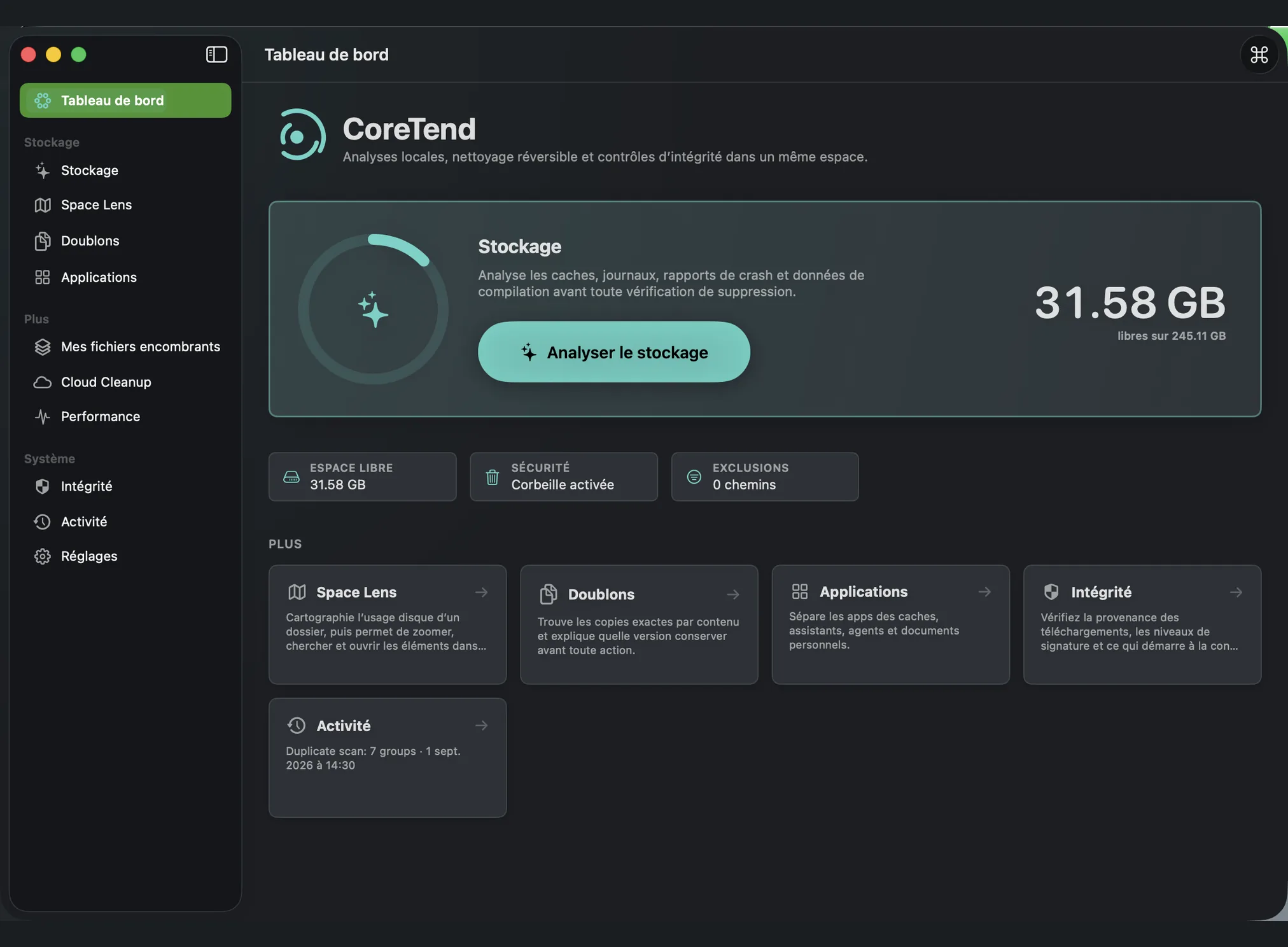
Dashboard
Free space, Trash status, exclusions, recent activity, and a large scan action at the centre with shortcuts into the other workflows.
- Scan
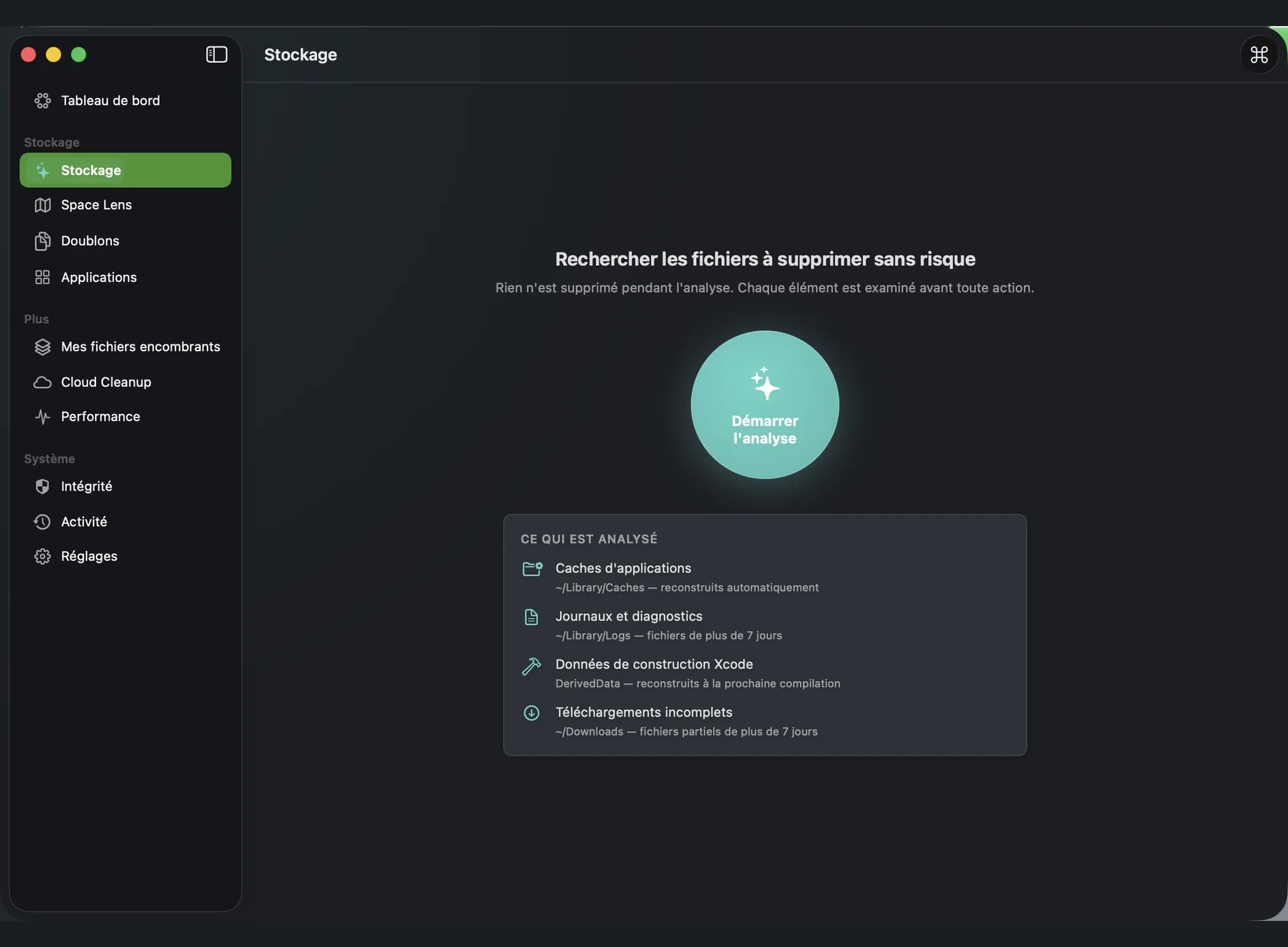
Storage
Caches, logs, crash reports, leftover installers, build data and forgotten downloads.
- Map
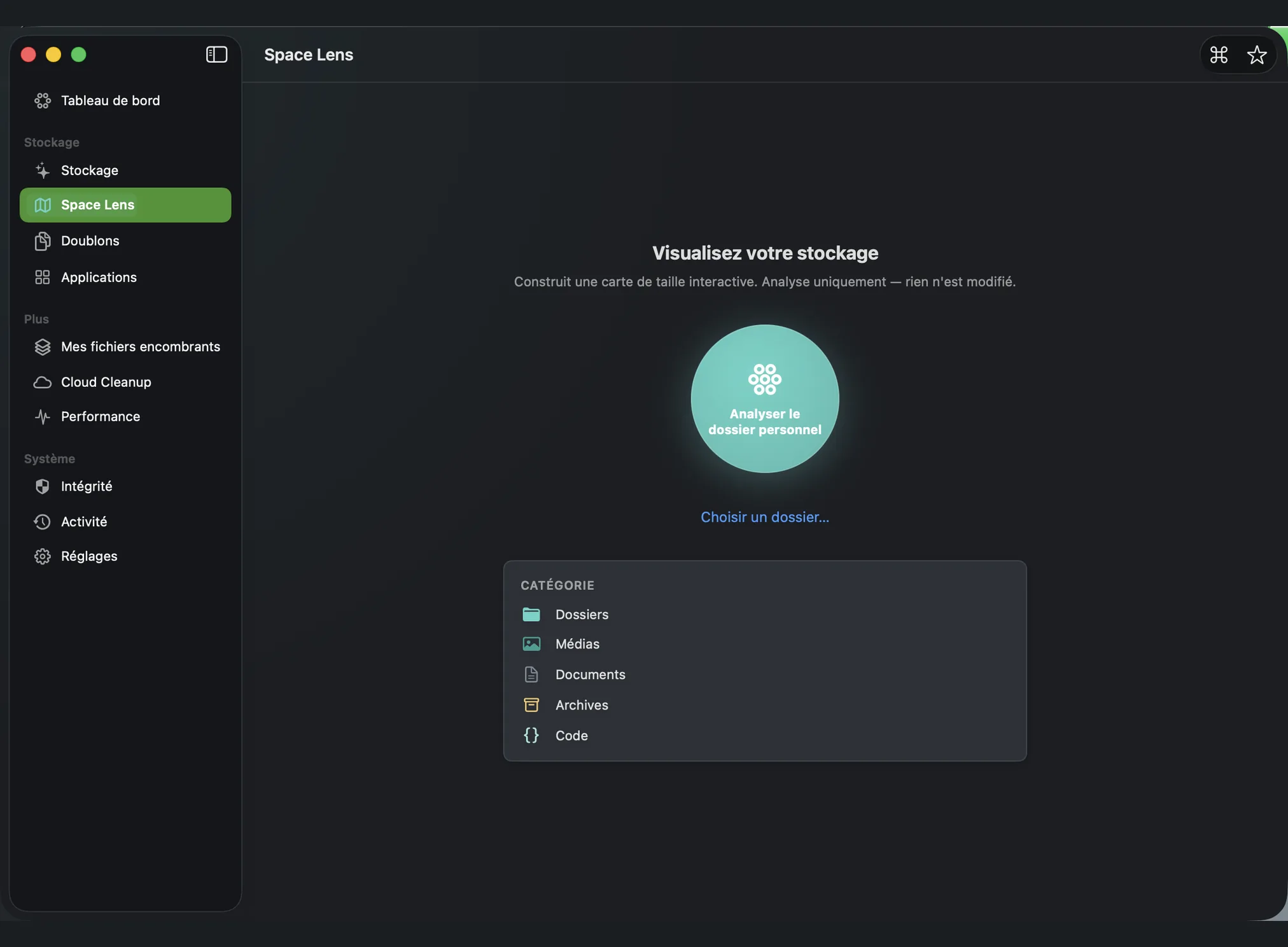
Space Lens
A radial size map — the largest folder at the centre, siblings orbiting it — that you can walk into, with breadcrumbs, search and Reveal in Finder.
- Match
Duplicates
Exact SHA-256 matching, keeper selection, Quick Look, Finder and CSV export.
- Apps
Applications
Inventory of /Applications and ~/Applications, bundle-ID-associated data and detected update source.
- Signals
Integrity
Download provenance, inspection of one selected app and launch-agent inventory. It is not an antivirus.
- Record
Activity
Up to 500 aggregate local activities, with filters, safety log and CSV or JSON exports.
- Control
Settings
Language, menu bar, exclusions, diagnostics, onboarding and manual update checking.
04 Findings
What a scan surfaces, and why.
A size on its own is not a decision. Every row carries the reason it was flagged, so saying no is as informed as saying yes.
05 Health
A read on the machine, not a cockpit.
CoreTend locally shows processor and memory use, free disk space and macOS's qualitative thermal state. The values below are interface examples, not measurements of your Mac.
06 Privacy
Built to be inspected, not believed.
A page promising privacy proves nothing. These are the inspectable boundaries: the code is public, scan data stays in one local database, and a manual update check contacts only the public release manifest.
- Local store~/Library/Application Support/CoreTend/store.sqlite
- NetworkNo telemetry, ads, account or device identifier. Manual update check via /latest.json.
- RemovalsExplicit selection, confirmation, macOS Trash and aggregate local activity.
- LicenceApache-2.0 · github.com/ahmetbsbnr/coretend
07 Install
Signed, notarized, and yours to verify.
CoreTend is Developer ID signed and notarized by Apple, so it opens with no Gatekeeper prompt. The SHA-256 and Minisign signature below let you verify provenance independently.
- 1
Open the .dmg, drag to Applications
- 2
Double-click it — it launches, no override needed
- 3
Optional: verify the SHA-256 and Minisign signature against the published key
91026c89313e7b36a546b395ae4ba21dee2542e0e7592c22a0cec8cdb5d86fde
08 FAQ
Answers before the download.
Does it send file names anywhere?
No. Scans stay on the Mac and this site has no analytics. There is no account, advertising, telemetry or device identifier. A manual update check requests only /latest.json and sends no file index.
Is it an antivirus?
No. The Integrity module reports macOS signals — provenance, quarantine, code signature, launch items. It does not detect malware and does not claim to.
Can I undo a removal?
CoreTend has no built-in restore action after removal. When macOS successfully placed an item in the Trash, use Finder → Trash → Put Back before emptying it.
How do I verify the download?
Compare the DMG’s SHA-256 with the published SHA256SUMS file, then check its Minisign signature with the published key (minisign.pub). xcrun stapler validate confirms the embedded notarization ticket.
What if I remove something I needed?
System locations are protected and each result remains inspectable before confirmation. Duplicates also searches Documents, and some categories start selected, so always review the selection and check the Trash after acting.
Is there a price, a subscription, an account?
No to all three. CoreTend ships under Apache-2.0, with no pro tier and no locked features. The repository contains everything you run.
See what yours is holding.
A scan moves nothing. That is the point.